
The grandfather clock in the downstairs hallway had not stopped ticking, but in the three weeks following David’s funeral, every stroke of its pendulum felt like an intrusive hammer against Eleanor’s skull.
Grief was not a sudden hurricane that passed and left clear skies in its wake; it was a slow, muddy tide that rose without sound, filling every corner of the house until breathing felt like swallowing gravel.
Every corner of the house bore David’s phantom touch.
His heavy work boots still stood neatly beside the front entryway, coated with dried reddish clay from the lumber yard.
His fleece jacket hung from the hook behind the kitchen door, carrying that lingering, faint trace of sawdust, peppermint gum, and the damp winter air he always dragged inside after an evening commute.
For twenty-one days, Eleanor had walked past that jacket without having the courage to touch it.
She lived in a fog of automatic survival: pouring cereal into Lily’s plastic bowl, washing small spoons, answering condolences from well-meaning neighbors who brought casseroles in disposable aluminum trays that piled up untouched in the refrigerator.
And then there was Lily.
The child did not speak of the cemetery.
She did not speak of the black casket lowered into the frozen November earth while relatives held umbrellas against a sleeting drizzle.
To Lily’s five-year-old mind, her father had merely gone away on a very long shift at work.
Every afternoon at exactly five-fifteen, the hour David’s old blue pickup truck used to rumble up the gravel driveway, Lily would sit quietly on the third step of the front porch, clutching Barnaby against her chest, watching the empty bend of the road.
She would sit there until the streetlights flickered on, her little shoulders hunching against the encroaching evening chill.
Whenever Eleanor pleaded with her to come inside, Lily would only offer the same heartbreaking whisper:
“Daddy said he was coming back to finish my dollhouse, Mommy.”
“He just has to work overtime.”
Each time those words slipped through Lily’s small lips, Eleanor felt a jagged fissure widen inside her chest.
How could she destroy the child’s hope when that fragile hope was the only anchor keeping Lily from falling apart?
On a cold Tuesday afternoon, when the wind whipped yellow maple leaves against the windowpanes, Eleanor finally gathered the strength to open the door to David’s study.
It was a small room at the end of the second-floor hallway, smelling of dry paper, aged cedar, and linseed oil.
Sunlight filtered through the half-closed horizontal blinds, casting thin bars of golden dust across the heavy oak desk David had inherited from his grandfather.
The desktop was orderly, exactly as he had left it the night his heart gave out.
A pair of reading glasses rested beside a stack of household utility bills, a pen with a chewed plastic cap lay over an open ledger, and a half-empty mug of cold black coffee sat dry on a ceramic coaster.
Eleanor approached the desk as if approaching an altar.
Her knees trembled under the weight of her oversized grey sweater.
She ran her palm across the cool, polished oak surface, leaving a streak through the faint layer of accumulated dust.
She needed to find the deed to the property and the life insurance policy documents the lawyer had requested.
She pulled open the top drawer: paper clips, receipts, rubber bands, a pocketknife with a staghorn handle.
She opened the middle drawer: tax returns organized by year in neat manila folders.
Then she reached for the bottom right drawer—the deep file drawer that David had always kept strictly locked.
He had jokingly claimed it held his top-secret blueprint sketches for home renovations, but he had always worn the small brass key around his neck on a leather cord.
The key was now on Eleanor’s bedside dresser, removed alongside his silver wedding band at the mortuary.
Her hands shook so violently that she dropped the small key onto the rug twice before finally guiding it into the brass keyhole.
With a dry click, the tumbler gave way.
She pulled the heavy wooden drawer open.
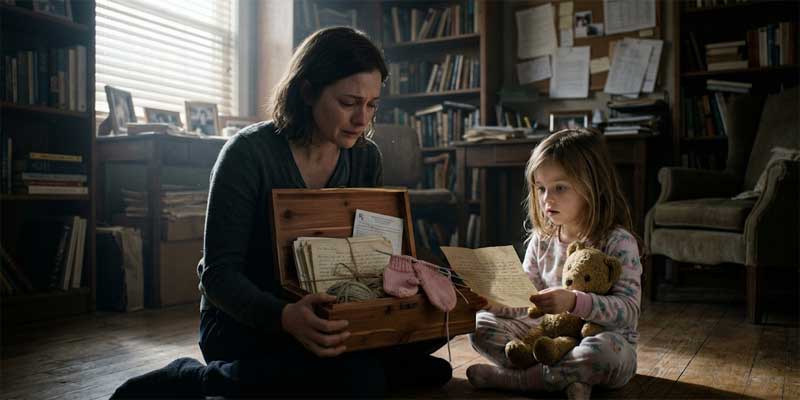
Inside, resting on top of a stack of bank deposit slips, was a polished box made of aromatic red cedar, roughly ten inches long and five inches deep.
The wood was smoothed by hand, its edges rounded with meticulous care, clearly crafted in his workshop during those late nights when he claimed he was repairing lawn equipment.
Carved into the lid was a single phrase in uneven cursive:
For Eleanor and My Little Lily-Bug.
Eleanor’s breath hitched in her throat, a sharp pang gripping her ribs so tightly she had to steady herself with both hands on the edge of the desk.
She lifted the cedar box out of the drawer.
It was heavier than it looked.
She carried it over to the braided rug in the center of the room and sat down cross-legged, the draft from the floorboards chilling her ankles.
Just as she rested her fingers on the small brass latch, soft footsteps padded down the hall.
Lily stood in the open doorway.
She was wearing her bunny pajamas again, her blond hair tangled, dragging Barnaby by his single stitched ear.
“Mommy?” Lily asked, her voice small and curious.
“Are you playing in Daddy’s room?”
Eleanor quickly wiped the corner of her eye with her sleeve and forced a gentle, fragile smile.
“Come here, sweetheart,” Eleanor murmured, patting the braided rug beside her.
“Look what Daddy left for us.”
Lily’s eyes instantly illuminated with that pure, boundless excitement that only children possess.
She scrambled across the floor, dropping to her knees next to Eleanor, pressing her small shoulder against Eleanor’s side.
“Did he leave a surprise? Did he bring the blue paint for my dollhouse?” Lily asked eagerly, peering at the dark red wood.
“Let’s see, baby,” Eleanor whispered, her throat aching with unshed tears.
With a faint metallic snap, Eleanor lifted the lid of the cedar box.
The scent of fresh cedarwood and dried rose petals immediately escaped into the cold room.
The first thing sitting at the very top was not a deed or an insurance certificate.
It was a thick white medical folder bearing the bold seal of the County Regional Hospital, dated nearly two years prior.
Eleanor opened the folder with numb fingers.
Her eyes scanned the dense clinical typography: Dilated Cardiomyopathy… severe ventricular degradation… refractory end-stage condition… surgical intervention unsuitable due to vascular complications… estimated survival: 12 to 18 months.
The room seemed to tilt sideways.
Two years.
He had known for almost two entire years.
Memories crashed over Eleanor like a violent, suffocating wave: all those nights David came home exhausted, massaging his sternum with a weary smile; the times he quietly sat down on the front steps, catching his breath while pretending he was admiring the sunset; the strange mornings he refused breakfast, claiming his stomach was slightly upset.
He had carried the crushing weight of his own death sentence in absolute, solitary silence every single day, never allowing a single shadow of fear to darken their home.
Beneath the medical records lay a thick bank passbook with a handwritten note taped to the cover:
Mortgage completely cleared. Lily’s college tuition deposited in high-yield bond. No debts remain. You two will be safe.
Eleanor pressed her knuckles against her teeth to stifle the scream building in her throat.
He had worked eighty hours a week while his heart was literally tearing itself apart from the inside, all to ensure that his widow and five-year-old child would never face an eviction notice or an unpaid bill.
“Mommy, look!” Lily gasped softly, her little fingers reaching into the bottom of the box.
“Look at the letters!”
Underneath the financial papers was a stack of fourteen cream-colored envelopes, neatly wrapped with a strip of faded blue twine.
On each envelope, written in David’s heavy, familiar pencil handwriting, was a specific title:
To Lily on Your 6th Birthday.
To Lily on Your 7th Birthday.
To Lily on Your 8th Birthday.
The stack continued systematically, year after year, all the way to a thick, bulging envelope marked at the bottom:
To My Little Lily-Bug on Your 18th Birthday and the Day You Graduate.
He had written a letter for every single milestone of her childhood that he knew he would never live to see.
Beside the stack of envelopes lay another item that stopped Eleanor’s breath entirely.
It was a pair of hand-knitted mittens made from soft, thick pink yarn.
The left mitten was completely finished, with tiny ribbed cuffs and tight, clumsy stitches that showed the awkward, unpracticed effort of a man who worked with chainsaws and lumber axes.
The right mitten, however, remained unfinished.
Two wooden knitting needles were still stuck through the top rows of yarn, with loose loops of pink thread dangling loosely from the thumb hole.
Next to the needles lay a torn piece of yellow lined notebook paper, covered in David’s shaky, uneven handwriting—clearly penned in his final days when his hands had begun losing their strength.
Eleanor picked up the paper with trembling fingers.
Her tears fell freely now, splashing onto the blue lines, smearing the graphite pencil marks.
“Read it, Mommy,” Lily whispered softly, her hand stroking the soft pink wool of the unfinished mitten.
“Is that a story from Daddy?”
Eleanor swallowed the hard lump in her throat, struggling to find her voice through the violent contractions of her chest.
She began to read aloud, her words shaking like autumn leaves caught in a storm:
“To my dearest Eleanor, and to my sweet little Lily-bug,” the letter began.
“If you are reading this, it means my tired old engine finally gave up the fight.”
“Please don’t be angry with me, Ellie, for keeping the truth locked away in this drawer.”
“If I had told you, every morning would have been filled with sorrow and fear, and I wanted our last two years to be filled only with laughter, warm dinners, and Lily’s sweet singing.”
“I wanted to give you memories of a living father, not a dying patient.”
Eleanor’s chest heaved, a ragged sob tearing from her lips as she pressed the paper closer to her eyes.
Lily watched her mother intently, her small hand creeping forward to wipe away a tear rolling down Eleanor’s jaw.
“Don’t cry, Mommy… what else does it say?” Lily murmured softly.
Eleanor choked down her grief and continued reading:
“Lily-bug, my precious little angel,” David had written in the second paragraph.
“I know that the world feels very cold right now.”
“I know you probably asked why Daddy was sleeping so deeply, or why his hands were not warm anymore.”
“The truth is, my sweet girl, a father’s body can grow tired, but his love never runs out.”
“I tried to learn how to knit these mittens for you during the nights when the pain kept me awake.”
“Mrs. Gable down the street gave me some lessons, but as you can see, Daddy’s big lumberjack hands weren’t very good with tiny knitting needles.”
“I couldn’t even finish the second thumb before my fingers became too stiff to hold the yarn.”
“I’m sorry I couldn’t finish it, Lily.”
“Whenever you feel cold, whenever the world seems lonely or scary, slip your little hands into this pink wool.”
“Every single stitch was woven with my prayers for your happiness.”
“Whenever you wear them, remember: my hands didn’t turn cold because I stopped loving you.”
“They turned cold because I poured every single drop of warmth I had left into your future.”
“Be brave, my sweet Lily.”
“Listen to your mother. Eat your vegetables. Sing as loud as you want.”
“I will be watching over you from the quiet sky until the day you come home to me.”
“Love forever and always, your Daddy.”
Silence hung heavy over the room, broken only by the sound of Eleanor’s quiet, broken weeping.
Lily did not cry right away.
She picked up the finished left mitten with both hands.
It was thick, clumsy, and oversized for her tiny five-year-old fingers, but she slowly slid her left hand inside the cuff.
She brought the pink wool up to her face, pressing it against her nose and inhaling deeply.
It smelled like cedar.
It smelled like pine soap.
It smelled like her father.
A single, fat tear spilled from Lily’s wide blue eyes, rolling down her cheek and landing softly upon the pink yarn.
“Mommy…” Lily whispered, her chin trembling violently as she held up her mitten-covered hand.
“It’s warm.”
“Daddy’s mitten is warm.”
Eleanor pulled Lily into her arms, wrapping her sweater around the little girl, weeping openly into her blond curls as they sat together on the floor of the sunlit study.
“Yes, baby,” Eleanor sobbed, kissing the top of Lily’s head over and over again.
“It’s so warm… He made it just for you.”
Lily laid her head against Eleanor’s chest, clutching the unfinished mitten and the wooden needles against her stomach with her other hand.
“Mommy?” Lily asked quietly, staring out the window at the distant trees swaying in the autumn wind.
“Can we keep the letters on my bookshelf?”
“Yes, my love,” Eleanor said softly, stroking her daughter’s back.
“We will keep every single one of them.”
“And when it’s my birthday next year…” Lily’s voice grew faint and hesitant, filled with a delicate, fragile hope.
“Will you read me what Daddy wrote for when I turn six?”
“Every single word, Lily. Every single word.”
Lily looked down at the unfinished thumb of the second mitten, running her tiny thumb over the loose pink yarn.
“Mommy, can you teach me how to knit?” Lily asked, her voice steadying slightly through her tears.
Eleanor paused, looking down at the innocent face of her daughter.
“Why, sweetheart?”
“Because Daddy didn’t get to finish the thumb,” Lily whispered, her eyes shining with fierce, loving determination.
“I want to finish it for him.”
“So when I grow big, his mitten will be whole again.”
Eleanor pulled Lily tighter against her heart, closing her eyes as the sunlight warmed the braided rug beneath them.
For the first time in three weeks, the suffocating chill in the house seemed to retreat just an inch.
David was gone, his hands forever cold beneath the frozen soil of the valley cemetery.
Yet in that dusty, cedar-scented room, surrounded by fourteen unread letters and a ball of tangled pink yarn, his warmth remained alive—etched irrevocably into the hearts of the two people he had loved more than life itself.